
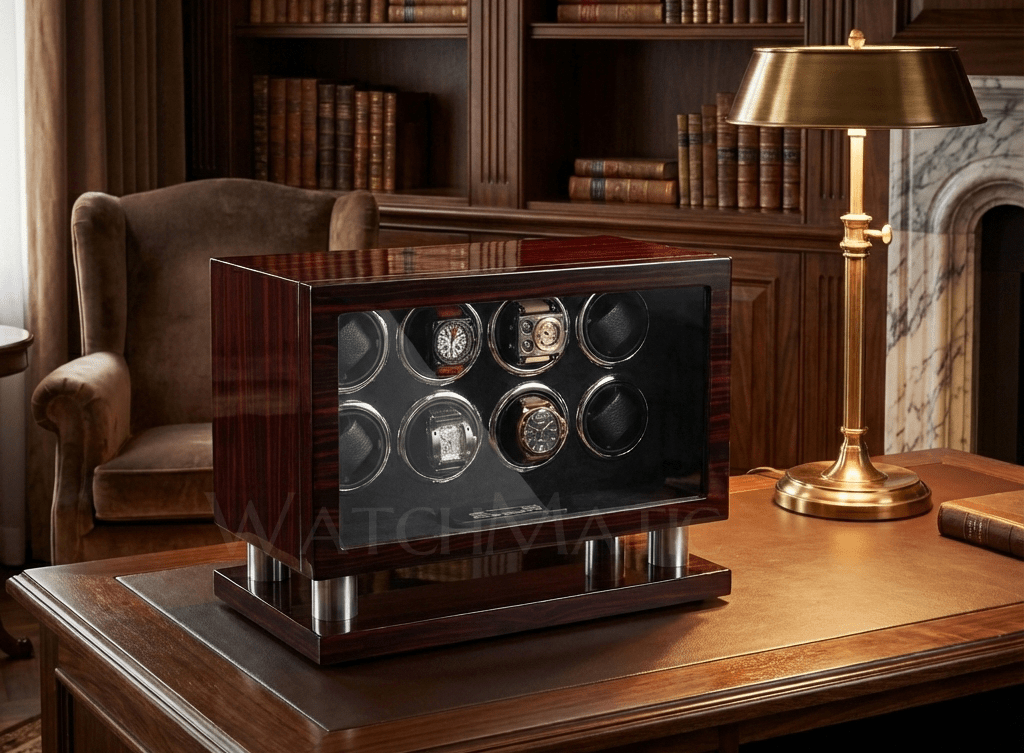
A watch winder keeps an automatic watch running by gently rotating it to maintain power reserve when the watch is not worn.
It does not improve accuracy, repair mechanical issues, or replace proper servicing.
Understanding what a watch winder actually does—and what it doesn’t—helps collectors use it correctly and avoid unrealistic expectations.
For many collectors, watch winders sit at the intersection of convenience and care. Some see them as essential tools; others view them as unnecessary or even harmful. The truth, as usual, sits somewhere in between.
Let’s clarify the role of a watch winder without marketing language or myths.
What Watch Winders Actually Do
They Maintain Power Reserve
At their core, watch winders exist for one purpose:
to keep automatic watches wound when they’re not being worn.
By rotating the watch at controlled intervals, a winder mimics natural wrist motion. This keeps the mainspring tensioned so the watch continues running instead of stopping after its power reserve depletes.
For collectors who rotate multiple watches, this means:
- The time and date remain set
- Complications stay synchronized
- Watches are ready to wear without resetting
That convenience is real - and often the primary reason collectors use them.
Many collectors rely on watch winders to keep their automatic watches running when they’re not worn, especially when rotating between multiple timepieces.
They Support Consistent Operation for Stored Watches
When used correctly, a watch winder can help maintain operational consistency for watches that spend extended periods off the wrist.
Proper winding cycles:
- Keep lubricants distributed
- Prevent repeated stop-start cycles
- Reduce the need for frequent manual winding
This is especially relevant for watches worn weekly or seasonally rather than daily.
They Reduce Daily Handling
Collectors often overlook this point.
Resetting a watch involves:
- Unscrewing the crown
- Adjusting time and date
- Re-securing the crown
Over time, repeated handling increases wear on crowns, stems, and seals. A winder reduces how often this interaction is necessary—particularly for watches with screw-down crowns or complex calendar mechanisms.
What Watch Winders Do Not Do
They Do Not Improve Accuracy
A common misconception is that a watch runs more accurately because it’s on a winder.
Accuracy is determined by:
- Movement regulation
- Condition of components
- Proper servicing
A winder simply keeps the watch running. It does not regulate or fine-tune performance.
If a watch gains or loses time, a winder will not correct it.
They Do Not Fix Mechanical Issues
Watch winders are not diagnostic tools.
They cannot:
- Repair worn parts
- Resolve lubrication breakdown
- Correct rotor inefficiencies
- Address power reserve loss
If a watch stops prematurely—even on a winder—it’s often a sign that servicing is due.
They Do Not Replace Regular Servicing
No matter how advanced a watch winder is, it cannot replace proper mechanical maintenance.
Automatic watches still require:
- Periodic cleaning
- Lubrication renewal
- Regulation
A winder can support day-to-day care, but it does not extend service intervals indefinitely.
They Do Not Suit Every Watch or Every Owner
Not every collector needs a watch winder.
If you:
- Own one automatic watch
- Wear it daily
- Don’t mind resetting it occasionally
A winder may offer little benefit beyond convenience.
For some collectors, especially minimalists, manual winding and regular wear are perfectly sufficient.
When Watch Winders Make the Most Sense
Watch winders are most practical when:
- You rotate between multiple automatic watches
- Watches are worn infrequently but stored long-term
- Complications make resetting time-consuming
- You want to minimize crown handling
- Movements differ and require specific winding behavior
In these cases, a winder becomes a tool—not a luxury.
The Collector’s Perspective
Many experienced collectors describe the same realization after using a watch winder properly:
“It didn’t change how my watches ran—it changed how I interacted with them.”
That distinction matters.
A watch winder doesn’t enhance the watch itself.
It enhances the ownership experience—when expectations are realistic.
Final Thoughts
Watch winders are often misunderstood because they’re judged by what people expect them to do, rather than what they’re designed for.
They:
- Keep automatic watches running
- Support consistent use
- Reduce daily handling
They do not:
- Improve accuracy
- Replace servicing
- Repair mechanical problems
Used with clear understanding, a watch winder is neither essential nor excessive—it’s simply appropriate in the right context.
And for collectors who manage multiple automatic watches, that clarity makes all the difference. For further insights into watch winding standards, you can read our full industry report on The Sun Bulletin.


